Showing posts with label Durga Puja. Show all posts

Saturday, October 4, 2008

Durga Pujo 2008 in Bangalore

Bangalore is all set to host the biggest Bengali festival of the year. Vedic chants and sounds of the dhak (drum), will rend the air, with Maha Shasthi (arrival of Goddess Durga) beginning on Sunday.
Various organizations in the city are gearing up to celebrate the festival with grandeur. Poorva Bangalore Cultural Association (PBCA) will celebrate the festival in VSR Convention Hall, Brookefields, with pujas, cultural programmes and competitions.
On all five days (till Dashami), arrangements have been made for rituals like aarati and pushpanjali (flower offerings).
This year, one of the major attractions will be a recitation by veteran actor Soumitra Chatterjee at 8 pm, who is also going to inaugurate the event, on Sunday.
Every evening, there will be a cultural programme with a blend of classical and popular items, performed by local and invited artistes. Singer Indrani Sen will perform on Monday.
The Bengalee Association in Ulsoor will have its pandal on the RBNAMS ground. There’ll be a number of cultural programmes, including a children’s ballet on environmental issues on Sunday, performances by singer Anup Ghoshal and dancer Dona Ganguly’s troupe on Tuesday, and rock band Dhoomketu on Wednesday.
The Koramangala Sarathi puja will have rock bands Krosswindz and MO2 performing on Sunday and Monday. Boogie Boogie, a dance competition and fashion show, will be held on Tuesday, and an antakshari competition will be organized on Wednesday.

Tuesday, September 23, 2008

History of Mahalaya

Mahalaya is a national festival and has two dimensions i.e Devaparva or prayers offered to God and Pitarparva or penance and worship of your ancestor. The latter is also named Shraddha or food offered with a sense of gratitude and affection. In The pitarpaksha season for 15 days Hindu pay their respect near a lake or a river called Pindadana to all his relatives and deceased elders or a common platform. This is also the most appropriate occasion for tantric tradition and offering to Goddess Chandi.

The traditional six day countdown to Mahasaptami starts from Mahalaya. Goddess Durga visits the earth for only four days but seven days prior to the Pujas, starts the Mahalaya. The enchanting voice of Birendra Krishna Bhadra fill up the predawn hours of the day thus marking the beginning of "devipaksha" and the beginning of the count-down of Durga Puja.
Durga Puja spans over a period of ten days but the main part of the Puja is limited to four days. In Hindu tradition, the fifteen days from the new moon up to the next full moon is called as Debi/Devi Paksha, and is regarded as the best time for doing any sacred, religious and auspicious activity or event. On the day of the last new moon before the Mahalaya, the eyes of the idols are designed and the process is called Chakshudaan and with Mahalaya, the Durga Puja commences.
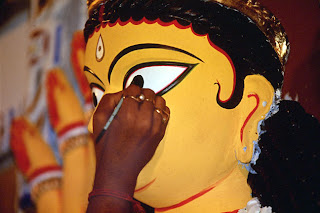
Chakshudaan - shaping the eyes

Sarat in its bloom, mingled with the festive spirit of Durga Puja reaches its pitch on the day of Mahalaya.It is according to the myths that Sree Rama hastily performed Durga Puja just before he set for Lanka to rescue Sita from Ravana. According to Puranas, King Suratha, used to worship the goddess Durga in spring.
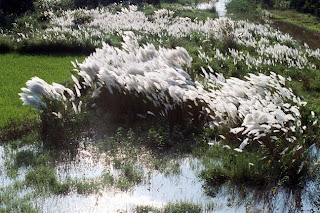
Seasonal "kaash" flower blooms during Sarat
Thus Durga Puja was also known as Basanti Puja. But Rama proponed the Puja and worshiped Durga in autumn and that is why it is known as 'Akal Bodhon' or untimely worship. It was considered untimely as it is in the myths that puja was performed when the Gods and Goddesses were awake i.e. "Uttarayan" and was not held when the Gods and Goddesses rested ie."Dakshinayan". It was on the day of Mahalaya, the beginning of "devipoksha", the Gods and Goddesses woke up to prepare themselves for Durga Puja.

According to another legend, the renowned hero of the Mahabharata, Karna, when he left the mortal coil, ascended to the higher worlds and the great charity he had done here was returned to him hundredfold. But, it was all gold and silver; there was no food, as he had not done any food-charity! He prayed to the god of death. So, he was sent back to earth for fourteen days, to make up for this deficiency. For fourteen days, he fed Brahmins and the poor, and offered oblations of water. On his return to the higher regions, he had food in plenty. It is these fourteen days that are commemorated in the Mahalaya Paksha. Due to the grace of the god of death, it has been ordained that offerings made during this period benefit all the departed souls, whether they are connected to you or not. Charity in the form of food is important during this observance. Life depends upon food. You cannot preach religion to empty stomachs. This human body is the most important vehicle for realising God. How precious must food be which keeps the body fit for Yoga! The gift of food is the greatest gift.

Therefore, give food in plenty, not only during the Mahalaya fortnight but all through the year.
Saturday, October 20, 2007

Worshiping Maa Durga

DURGA PUJA
THE WORSHIP OF MA DURGA …


Here I describe the meaning behind this religious celebration (mainly for the benefit of the non-Indian born Bengali’s) …


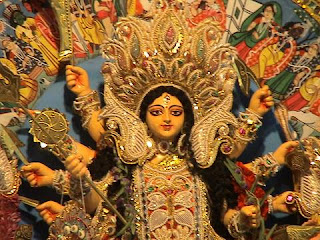
We worship Durga as the mother goddess, the epitome of 'Shakti' (divine power), to deliver us from the evil and bring peace and prosperity in our lives. But the most interesting part of Durga Puja is that, instead of placing Durga on a high alter and worshipping her from a distance the Bengalis embrace her in their hearts and make her an inseparable member of the family. We welcome Durga to the earth as our daughter who comes at her parents' home for her annual visits.


Durga stays for four days - Shashti, Saptami, Ashtami and Nabami along with her children, Ganesha, Laxmi, Kartik and Saraswati and sets for her husband's abode on Vijaya Dashami.


Durga's mode of journey to the earth is detailed in the scriptures. The modes - an elephant, a horse, palanquin, boat - all signify luck or omen which influence life on earth. The elephant signifies prosperity and good harvest, while journeying on a horse back indicates drought, a palanquin spells widespread epidemic; and the boat suggests flood and misery.


According to the Puranas, King Suratha, used to worship the goddess Durga in spring - thus Durga Puja was also known as Basanti Puja.


The worship of Devi Durga however owes its origin to Sree Rama. In the 'Ramayana', as it goes, Rama went to 'Lanka' to rescue his abducted wife, Sita, from the grip of Ravana, the king of the Demons in Lanka. Before starting for his battle with Ravana, Rama wanted the blessings of Devi Durga. He came to know that the Goddess would be pleased only if she is worshipped with one hundred 'NeelKamal' or blue lotuses. Rama, after travelling the whole world, could gather only ninety nine of them. He finally decided to offer one of his eyes, which resembled blue lotuses. Durga, being pleased with the devotion of Rama, appeared before him and blessed him.


The epical battle started on the 'Saptami' and Ravana was finally killed on the 'Sandhikshan' - the crossover period between Ashtami (the next day) and Navami (the day after). Ravana was cremated on Dashami. This is why Dashera is celebrated in India with so much of fanfare and the effigy of Raavana is burnt.


In the course of time Bengalis adopted the autumnal worship of Durga performed by Rama and made it their main festival and that is why it is known as 'Akal Bodhon' or untimely worship. The Pujas span over the four days, the time taken by Rama to finally kill and cremate Ravana.


Durga Puja Days


MAHALAYA
The traditional six day countdown to Mahasaptami starts from Mahalaya. Goddess Durga visits the earth for only four days but seven days prior to the Puja’s, starts the Mahalaya. The enchanting voice of Birendra Krishna Bhadra fill up the predawn hours of the day thus marking the beginning of "devipaksha" and the beginning of the count-down of Durga Puja. Sarat in its bloom, mingled with the festive spirit of Durga Puja reaches its pitch on the day of Mahalaya.


From this day starts 'Devipaksha' and marks the end of 'Pitri-paksha'. It is the day when many throng to the banks of river Ganga, clad in dhotis to offer prayers to their dead relatives and forefathers. People in the pre-dawn hours pray for their demised relatives and take holy dips in the Ganges. This ritual is known as 'Torpon'. This day bears immense significance for the Bengalis. It is according to the myths that Sree Rama hastily performed Durga Puja just before he set for Lanka to rescue Sita from Ravana.


According to the Puranas, King Suratha, used to worship the goddess Durga in spring. Thus Durga Puja was also known as Basanti Puja. But Rama proponed the Puja and worshiped Durga in autumn and that is why it is known as 'Akal Bodhon' or untimely worship. It was considered untimely as it is in the myths that the puja was performed when the Gods and Goddesses were awake i.e. "Uttarayan" and was not held when the Gods and Goddesses rested i.e. "Dakshinayan". It was on the day of Mahalaya, the beginning of "devipoksha", the Gods and Goddesses woke up to prepare themselves for Durga Puja.


The five (5) festive days of Durga Puja welcoming Devi Durga is aplomb with rituals and accompanied with dhak, dhunuchi and shiuli …


SASTHI
Shashti, the sixth day of the moon when Goddess Durga is welcomed with much fanfare and gusto. Look for the 'Bodhon' rituals when the face of the Durga is unveiled.


SAPTAMI
Saptami features the first day of Durga puja; commencement of rituals; predawn bathing of 'Kola Bow'.


ASTHAMI
Most important day of Durga Puja; celebrating Durga's victory over Mahishasur; devotees recite the mantras and offer flowers to Devi Durga (pushpanjali) and pray for her blessings; rituals of animal sacrifices; animals are now substituted with 'chalkumro' (type of pumpkin), cucumber and banana.


NAVAMI
Last day of Durga Puja; commencement of 'Sandhi Puja'. Nabami Bhog... Goddess Durga is offered food which is later distributed among the devotees. "Sandhi puja" - End moment of Ashtami and the beginning of Nabami is the time for Sandhi Puja. At this time Devi Durga transformed into Devi Camunda to kill "Chando" and "Mundo", the two generals of Mahishasura (the Buffalo Demon).


DASHAMI
Dashami is the day when Goddess Durga accompanied with her children sets for Kailash, her husband's abode. With a heavy heart the Bengalis immerse the clay idol of Durga in the sacred Ganges bidding her goodbye and earnestly waiting to see her again the next year.


"Sindur Khela" (Vermillion game) is a major event of Dashami. Married women apply vermilion to each other and greet each other with sweets. It is in the evening when Goddess Durga is immersed Bengalis greet each other with bijoya greetings and men follow the customary 'Kolakuli' (embrace each other).


Durga Puja is a festival, Bengalis celebrate without religious inhibitions.It is now more of a socio- cultural celebration that tends to renew kinship with friends and relatives.


No end of this road

No end of this road

WWF Member

WWF Member